


Fair Shot!
Horus Ent HK
Some puzzle games ask you to think several moves ahead, while Fair Shot! keeps its promise much closer to the hand: aim, throw, watch the result, and decide whether you want another attempt. I found that simplicity immediately appealing. The game is built around tossing balls at cans, so the first few seconds are easy to understand even if you have never played this kind of casual challenge before. There is no long tutorial to study and no complicated rule set standing between you and the first shot.
That directness is also the reason I would describe it as a small, focused game rather than a deep puzzle experience. Its appeal comes from the short action-and-reaction cycle. You make a shot, receive visual feedback, enjoy a successful hit when your timing is right, and then begin thinking about the next throw. The loop is uncomplicated, but it can be surprisingly effective when I only want something light during a break.
How the throw-and-reset loop feels in practice
The first action is clear, quick, and easy to understand
The opening interaction is the strongest part of the design. Fair Shot! puts the central task in front of you without burying it under menus or story elements: throw the ball and try to knock down the cans. That makes the game approachable for younger players, casual users, and anyone who prefers learning through action rather than instructions.
I like that the basic objective does not require a large time commitment. You do not need to prepare a character, build a deck, or remember a complicated set of abilities before playing. The first shot tells you almost everything important about the experience. If you enjoy the feeling of lining up a simple physical action and seeing an immediate result, the game gives you that feeling almost at once.
There is a useful distinction here between accessibility and depth. The controls are easy to grasp, but that does not automatically make every attempt easy. A simple target can still invite small adjustments in aim and timing. I found myself paying more attention after a miss because the next throw offered a chance to correct what I had just done. That is a modest form of puzzle-solving, based less on written clues and more on reading the outcome of the previous action.
Related News






For an everyday example, this is the sort of game I would open while waiting for a coffee, sitting on public transport, or taking a short pause between tasks. I would not choose it when I wanted a long narrative or an involved strategy session. I would choose it when I wanted to do something immediately, with no mental setup and no obligation to stay for a lengthy round.
Feedback gives each attempt a small lesson
The feedback rhythm is what keeps the simple premise from feeling completely empty. A hit confirms that the throw worked, while a miss gives me a reason to adjust. That action, result, and correction pattern is the heart of the game. It is not a complex progression system; it is a compact physical puzzle repeated until the player feels satisfied or decides to stop.
What matters is the timing between the throw and the result. When the response is easy to read, I can connect my decision with what happened on screen. That connection encourages experimentation. Instead of treating every failed attempt as a dead end, I can use it to change the next angle, release, or general approach. The game therefore works best when I play attentively rather than tapping without looking.
Gallery
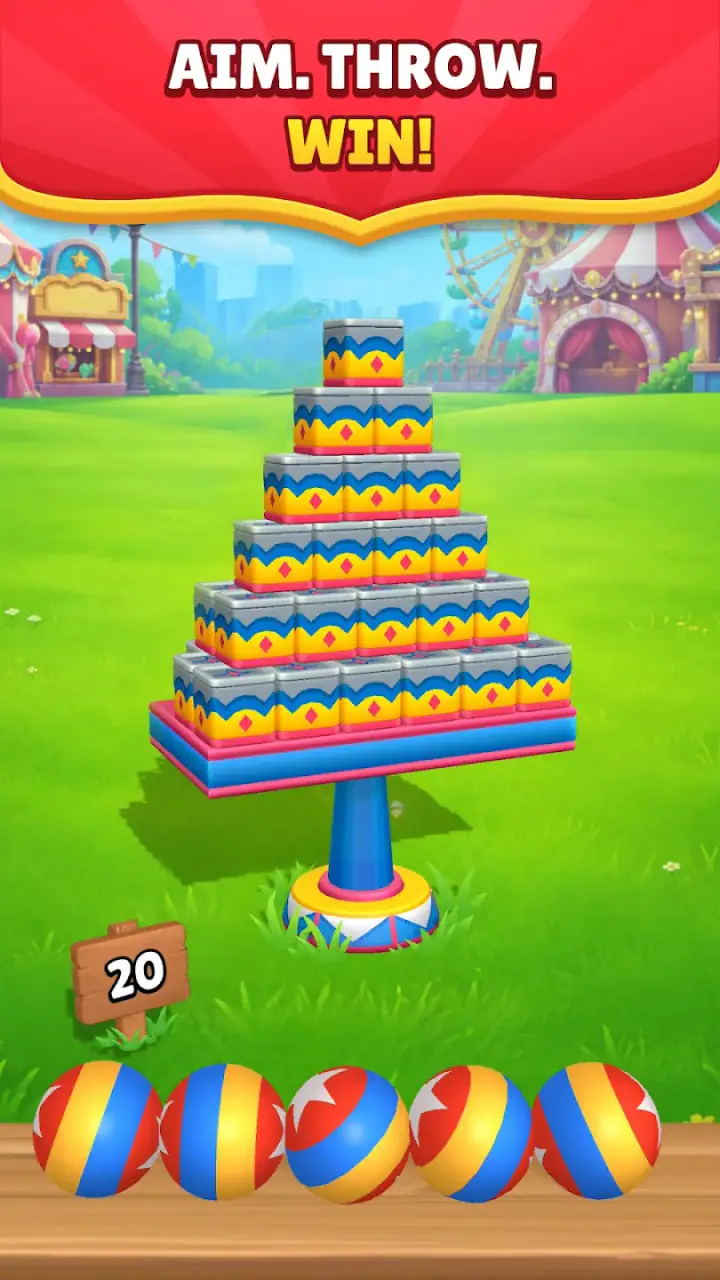
This is also where expectations should stay realistic. Fair Shot! should not be confused with a full physics sandbox or a large puzzle collection. Its appeal is narrower. The enjoyment depends on whether I find repeated aiming and immediate results satisfying. Players who need steadily changing mechanics may find the loop too restrained, while players who enjoy small tests of control may appreciate its uncomplicated rhythm.
One practical tip is to avoid rushing the next throw simply because the previous one failed. The short format can tempt quick, careless attempts, but the better use of the game is to treat every result as information. I get more from it when I pause briefly, identify what felt wrong, and make one deliberate adjustment. That turns a basic can-knocking activity into a more satisfying personal challenge.
Success feels better because the task stays readable
The reward in Fair Shot! is tied closely to the visible result of the throw. Hitting the cans provides the immediate satisfaction, and the game’s store summary captures that straightforward goal without needing a complicated explanation. I do not have to interpret a large interface to understand whether the attempt went well. The reward is direct: the target reacts, and I know I made progress in the moment.
That clarity makes the game suitable for players who prefer concrete feedback. Some puzzle games reward you with abstract points, long-term upgrades, or a chain of unlocks. Here, the immediate success of the shot is more important than a large surrounding system. I found that refreshing because the game does not ask me to maintain a complicated plan while I am simply trying to enjoy a few throws.
At the same time, the reward structure may feel light to users who expect a strong sense of progression. If your favorite games constantly introduce new equipment, characters, missions, or strategic layers, this experience may seem limited by comparison. Its reward is mainly the satisfaction of performing the central action well, not the promise of managing a large collection or developing a long-term build.
That trade-off affects who should install it. I would recommend it to someone looking for a casual puzzle game with an instantly understandable objective. I would be more cautious about recommending it to a player who wants deep systems, a substantial campaign, or a carefully expanding challenge structure. The game can be enjoyable without offering those things, but it should be approached for what it is rather than judged as a replacement for a larger puzzle title.
The reset makes another session feel natural
After a result, the experience naturally points back toward another attempt. This reset is important because it keeps the game from becoming a one-shot novelty. Once I have seen how a throw behaves, I immediately have a reason to try again: improve the aim, repeat a successful technique, or see whether a different approach produces a better outcome.
The reset also makes Fair Shot! well suited to interrupted play. I can give it a brief amount of attention, stop, and return later without needing to remember a complicated story or a multi-step objective. That is one of its most practical strengths. Many mobile games are technically portable but still demand long sessions; this one is easier to fit around ordinary routines because its central activity is self-contained.
There is a possible downside to the same design. A short loop can become repetitive if the player does not enjoy refining the same basic action. The reason to begin another session comes from wanting a better result or another satisfying hit, not from a dramatic narrative cliffhanger. For me, that is enough in small doses, but I would not expect it to occupy an entire evening.
I also think the reset works best when I set my own stopping point. A useful personal routine is to play until I either make a clean improvement or notice that I am throwing without paying attention. Once the attempts become automatic, the game loses much of its small puzzle appeal. Stopping at that moment keeps the experience feeling like a quick challenge instead of turning it into background tapping.
Where it sits among casual puzzle alternatives
Compared with match-three games, Fair Shot! asks for less planning across a board and more attention to a single physical action. Compared with word puzzles, it does not depend on vocabulary or general knowledge. Compared with large physics games, it presents a much narrower task. That makes it easier to enter, but it also means there is less variety if you want several different kinds of challenges in one app.
I would choose this game over a more elaborate alternative when I want immediate interaction and a clear result. I would choose a broader puzzle game when I want multiple modes, longer-term progression, or a challenge that changes substantially from one session to the next. Neither choice is automatically better; it depends on whether my priority is convenience or depth.
The game is also a reasonable option for a mixed-age household because its content rating is Everyone. That does not mean every player will enjoy the same thing, but the simple target-based premise is easier to share than a game built around mature themes or complicated competitive systems. Someone introducing it to a child should still explain the basic goal and observe whether the controls feel comfortable, but the concept itself is immediately approachable.
On the practical side, Fair Shot! is free to download, which lowers the barrier to trying it. The game includes in-app purchases ranging from $1.99 to $99.99 per item, so I would pay attention before confirming any purchase. The free entry makes sense for testing whether the throw-and-reset loop suits you, but the presence of optional spending means I would not hand a device to a child without checking the purchase settings first.
What the current release tells me about expectations
The game comes from Horus Ent HK and is currently at version 0.0.2.4, which suggests I should approach it as an early-stage experience rather than a fully mature puzzle platform. That does not make it unplayable, but it does shape my expectations. I would focus on whether the central action is enjoyable today instead of assuming that the game already offers the polish or breadth of a long-established title.
Its average rating is 3.9 from around 150 ratings, with about 10 written reviews. I read that as a mixed but useful signal: there is enough player response to show that the concept has attracted attention, yet the overall audience is still relatively small. I would use the rating as context, not as a final verdict. A player who likes short skill-based interactions may respond more positively than someone looking for a deep puzzle catalog.
The game has passed 100K installs, so it is not an obscure experiment with no audience at all. Still, the modest scale reinforces the same conclusion I reached while playing: this is a focused casual title whose value depends heavily on personal taste. Its strongest feature is the clear central loop, not a long list of systems surrounding it.
Device compatibility is another practical consideration. Fair Shot! requires at least Android 7.1, so users on older devices should check their operating system before trying to install it. For people with a compatible phone, the more important question is not whether the game is large or feature-packed, but whether a simple throwing challenge is the kind of interaction they want to repeat.
Who will enjoy it, and who should skip it
I think Fair Shot! is a good fit for casual players who like quick attempts, visible results, and light hand-eye challenges. It also suits people who dislike tutorials that take longer than the game itself. The uncomplicated structure makes it easy to recommend as a trial: install it, take a few shots, and you will quickly know whether the loop feels satisfying to you.
I would also suggest it to someone who wants a small distraction that can be paused without losing the thread of a larger adventure. Its compact format works well for short breaks, especially when I want active input rather than a passive app. The game gives me something to do immediately and does not require a large commitment before the first meaningful interaction.
I would skip it if my main reason for playing puzzle games is complex deduction, story development, or a broad set of changing mechanics. I would also look elsewhere if I become bored by repetition quickly. The game’s central action is its identity, so anyone hoping for a wide range of unrelated puzzles may feel that the experience is too narrow.
My final judgment is cautiously positive. The reason to return is simple: a shot creates feedback, feedback suggests a correction, and the reset makes improvement feel one attempt away. That is not enough to make Fair Shot! a universal recommendation, but it is enough to make it worthwhile for the right player.
After spending time with it, I see the game as a compact puzzle diversion rather than a major mobile destination. The free price makes trying it straightforward, the Everyone rating broadens its potential audience, and the recognizable can-throwing premise removes unnecessary friction. The purchase range means I would stay alert around optional spending, while the early version and focused design encourage realistic expectations.
If you want a quick game built around aiming, immediate reactions, and the urge to try one more throw, Fair Shot! is easy to understand and easy to test. I would recommend starting with short sessions and judging it by the quality of that small loop, not by features it was never designed to provide. When the action feels satisfying, the reset does its job and another session begins naturally. When it stops feeling engaging, there is no long investment to abandon, which is perhaps the game’s most honest advantage.
FAQs for Fair Shot!
What is Fair Shot!?
Fair Shot! is a mobile game focused on quick, skill-based shooting challenges. Players generally need to aim carefully, time their shots, and complete objectives while progressing through increasingly demanding levels. Its simple controls make it easy to start, but later stages can require patience and practice. The game is best suited to users looking for short, casual gameplay sessions rather than a long, story-driven experience.
Is Fair Shot! free to download and play?
Fair Shot! can typically be downloaded at no initial cost, allowing users to try its core gameplay before spending money. However, free mobile games may include advertising, optional in-app purchases, or both. These purchases can sometimes provide extra resources, remove advertisements, or unlock convenience features. Before downloading, it is worth checking the store listing for the current pricing, supported payment options, and any age-related purchase restrictions.
How does the gameplay and control system work?
The main gameplay in Fair Shot! revolves around controlling the direction, timing, or power of each shot. Depending on the level, you may need to hit targets accurately, avoid obstacles, or complete a challenge within limited attempts. The controls are designed to be accessible on a touchscreen, although precision becomes more important as difficulty increases. A stable grip and careful aiming can make a noticeable difference.
Does Fair Shot! require an internet connection?
Whether Fair Shot! works fully offline can depend on the version installed and the feature being used. Basic levels may be available without a constant connection, while advertisements, online rankings, cloud synchronization, updates, or purchases may require internet access. If you plan to play while traveling or with limited data, test the game in airplane mode after installation and review its permissions and store description.
Is Fair Shot! suitable for children and all types of players?
Fair Shot! is generally approachable because its controls and objectives are easy to understand, making it suitable for casual players and beginners. Nevertheless, parents should review the official age rating, advertising content, and in-app purchase settings before allowing younger children to play. Some users may also find repeated challenges or difficulty increases frustrating, while players who enjoy accuracy and short skill tests may find the experience particularly appealing.
Pros
- Quick
- easy-to-understand gameplay for short sessions.
- Bright visuals make the action easy to follow.
- Challenging shots help improve timing and accuracy.
- Simple controls are suitable for casual players.
- Progression gives you a reason to keep practicing.
Cons
- Gameplay can become repetitive after extended sessions.
- Difficulty may increase sharply in later stages.
- Limited variety may reduce long-term replay value.
- Some players may find the aiming mechanics frustrating.
- Performance can vary on older mobile devices.


